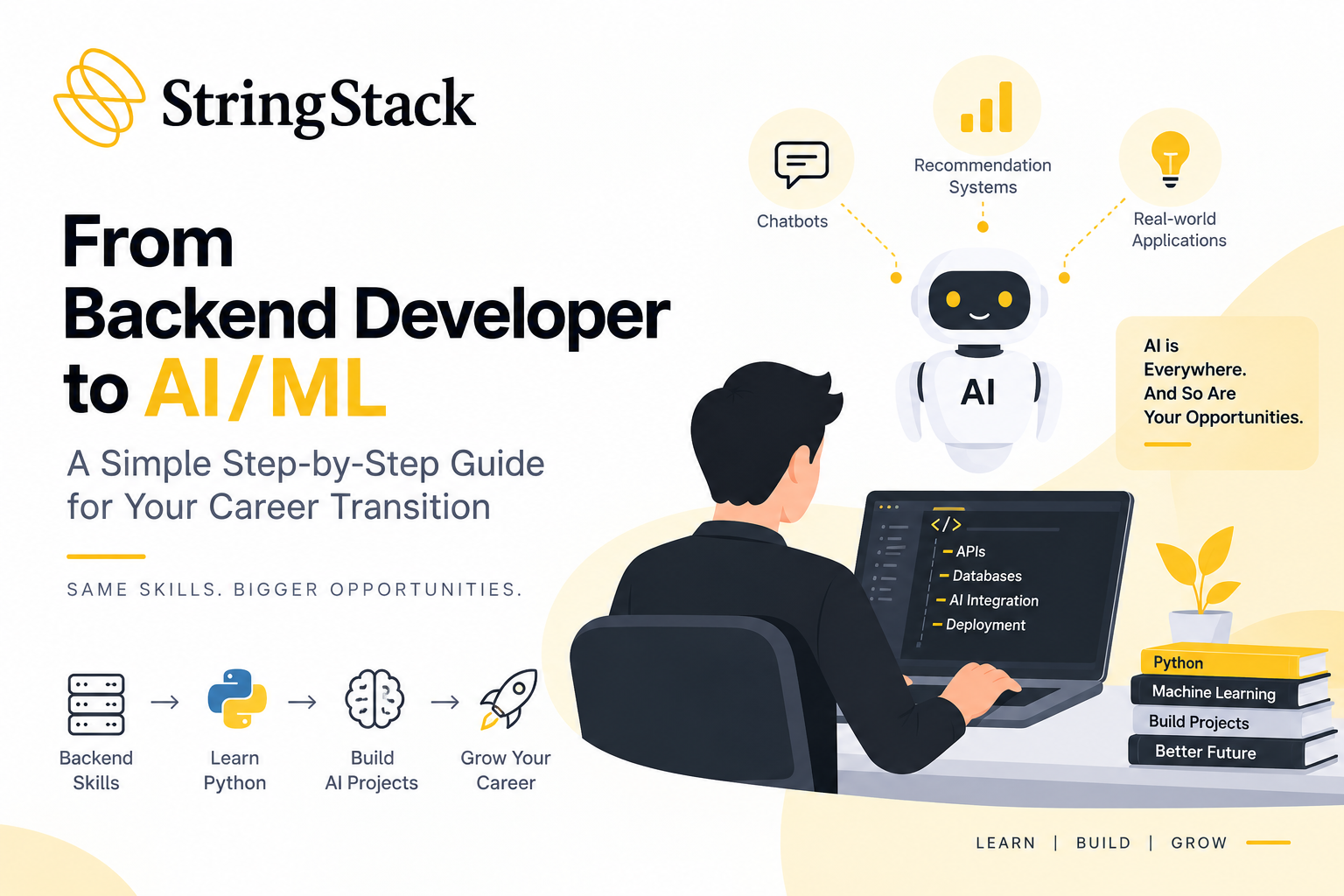
<p>Today, Artificial Intelligence and Machine Learning are growing very fast. From chatbots to recommendation systems, AI is being used in many real-world applications. Because of this, many backend developers are now interested in learning AI/ML and building a career in this field. </p>
<p>At first, AI may look complicated because of terms like Machine Learning, Neural Networks, and Deep Learning. Many developers think they need to become experts in mathematics or research before starting AI. But the reality is much simpler. </p>
<p>Backend developers already have many useful skills such as programming, APIs, databases, debugging, and problem-solving. These skills are very important in AI applications as well. </p>
<p><strong>Why Backend Developers Already Have an Advantage</strong> </p>
<p>Many backend developers do not realize this, but they already know many skills that are needed in AI applications. </p>
<p>Backend developers usually understand:</p>
<ul>
<li>Programming</li>
<li>APIs</li>
<li>Databases</li>
<li>Server-side development</li>
<li>Authentication</li>
<li>Debugging and problem-solving</li>
</ul>
<p>These skills are very important because AI models alone are not enough in real-world applications. </p>
<p>For example, if a company creates an AI chatbot, someone must:</p>
<ul>
<li>Connect it with websites</li>
<li>Store data in databases</li>
<li>Create APIs</li>
<li>Handle users and authentication</li>
<li>Deploy the application</li>
</ul>
<p>This work is mostly done by backend developers.</p>
<p>So, backend developers already have a strong starting point for learning AI/ML.</p>
<p><strong>Step 1: Learn Python Properly </strong></p>
<p>Before starting AI or Machine Learning, it is important to first learn Python properly because most AI tools and libraries are built using Python.</p>
<p>Many students make one common mistake:<br />
They directly jump into AI videos, ChatGPT tutorials, or Machine Learning projects without learning programming basics. After some time, they get confused because they cannot understand the code properly.</p>
<p>That is why Python basics are very important.</p>
<p>If your Python foundation is strong, then learning AI becomes much easier later. You will understand projects better, fix errors easily, and write code with more confidence.</p>
<p>First focus on:</p>
<ul>
<li>Variables</li>
<li>Loops</li>
<li>Functions</li>
<li>Lists and dictionaries</li>
<li>OOP concepts</li>
<li>File handling</li>
</ul>
<p>Do not try to complete everything quickly. Learn slowly and practice regularly.</p>
<p>Even writing small programs daily will improve your coding skills.</p>
<p><strong>Step 2: Understand What AI and Machine Learning Actually Mean </strong></p>
<p>After learning Python basics, the next step is understanding what AI and Machine Learning actually mean.</p>
<p>Many students directly start learning libraries and frameworks without understanding the concepts. Because of this, they become confused later.</p>
<p>First understand:</p>
<ul>
<li>What is Artificial Intelligence?</li>
<li>What is Machine Learning?</li>
<li>How AI systems learn from data</li>
<li>Real-world examples of AI</li>
</ul>
<p>All these are examples of AI applications.</p>
<p>At the beginning, focus on understanding ideas clearly instead of learning difficult theory.</p>
<p><strong>Step 3: Learn Important Python Libraries </strong></p>
<p>Once your basics become strong, then start learning important Python libraries used in AI/ML.</p>
<p>Libraries help developers perform tasks faster without writing everything from scratch.</p>
<p>Some important libraries are:</p>
<ul>
<li>NumPy for numerical operations</li>
<li>Pandas for handling data</li>
<li>Matplotlib for creating charts and graphs</li>
<li>Scikit-learn for Machine Learning models</li>
</ul>
<p>Do not try to memorize everything.</p>
<p>First understand:</p>
<ul>
<li>Why the library is used</li>
<li>What problem it solves</li>
<li>How to use basic functions</li>
</ul>
<p>Slow learning with practice is always better than fast learning without understanding.</p>
<p><strong>Step 4: Start Building Small Projects </strong></p>
<p>This is one of the most important steps.</p>
<p>Many students keep watching tutorials for months but never build projects. Because of this, they know theory but cannot apply it practically.</p>
<p>Projects help you:</p>
<ul>
<li>Improve confidence</li>
<li>Understand real-world problems</li>
<li>Learn debugging</li>
<li>Improve problem-solving skills</li>
</ul>
<p>Start with small beginner-friendly projects like:</p>
<ul>
<li>Spam message detector</li>
<li>Chatbot</li>
<li>Student marks prediction system</li>
<li>Resume analyzer</li>
<li>AI question generator</li>
</ul>
<p>Do not think:</p>
<p>“My project is too small.”</p>
<p>Every developer starts with small projects.</p>
<p>Small projects help you learn much more than only watching videos.</p>
<p><strong>Step 5: Learn AI APIs and Integrations</strong></p>
<p>Today, many companies do not create AI models completely from scratch. Instead, they use ready-made AI APIs.</p>
<p>This is where backend developers become very valuable.</p>
<p>Popular AI APIs:</p>
<ul>
<li><a href="https://platform.openai.com?utm_source=chatgpt.com">OpenAI API</a></li>
<li><a href="https://ai.google.dev?utm_source=chatgpt.com">Google Gemini API</a></li>
</ul>
<p>Backend developers can:</p>
<ul>
<li>Send prompts to AI systems</li>
<li>Build AI-powered APIs</li>
<li>Create automation systems</li>
<li>Connect AI with websites and applications</li>
</ul>
<p>This type of work is growing very fast in software companies.</p>
<p>If you already know backend development, learning AI integration becomes much easier</p>
<p><strong>Step 6: Learn Deployment Basics </strong></p>
<p>Building a project is not enough. Companies also need developers who can deploy applications properly.</p>
<p>That is why deployment is important.</p>
<p>Learn:</p>
<ul>
<li>REST APIs</li>
<li>Cloud basics</li>
<li>Database integration</li>
<li>Deployment concepts</li>
<li>Tools like Docker</li>
</ul>
<p>Backend developers already have an advantage here because deployment and APIs are part of backend development itself.</p>
<p><strong>Job Opportunities in Future </strong></p>
<p>Backend developers with AI knowledge can apply for roles like:</p>
<ul>
<li>AI Engineer</li>
<li>Backend AI Developer</li>
<li>AI Integration Engineer</li>
<li>ML Engineer</li>
<li>Generative AI Developer</li>
</ul>
<p>Many startups and companies now want developers who understand both backend systems and AI tools.</p>
<p>This demand will continue growing in the future.</p>
<p><strong>Conclusion:</strong></p>
<p>Backend developers already have many skills that are useful in AI and Machine Learning. Because of this, moving into AI/ML is much easier than many people think. </p>
<p>The important thing is to avoid confusion and learn step by step. Start with Python basics, understand AI concepts properly, practice regularly, and build small projects. </p>
<p>Do not try to become an expert immediately. Focus on consistency instead of speed.</p>
<p>Technology is changing very fast, and AI is becoming part of almost every software application. Developers who understand both backend development and AI will have very good opportunities in the coming years. </p>
<p>If you stay patient, practice regularly, and keep building projects, transitioning from backend development into AI/ML is completely possible.</p>
How Backend Developers Can Move into AI/ML in 2026