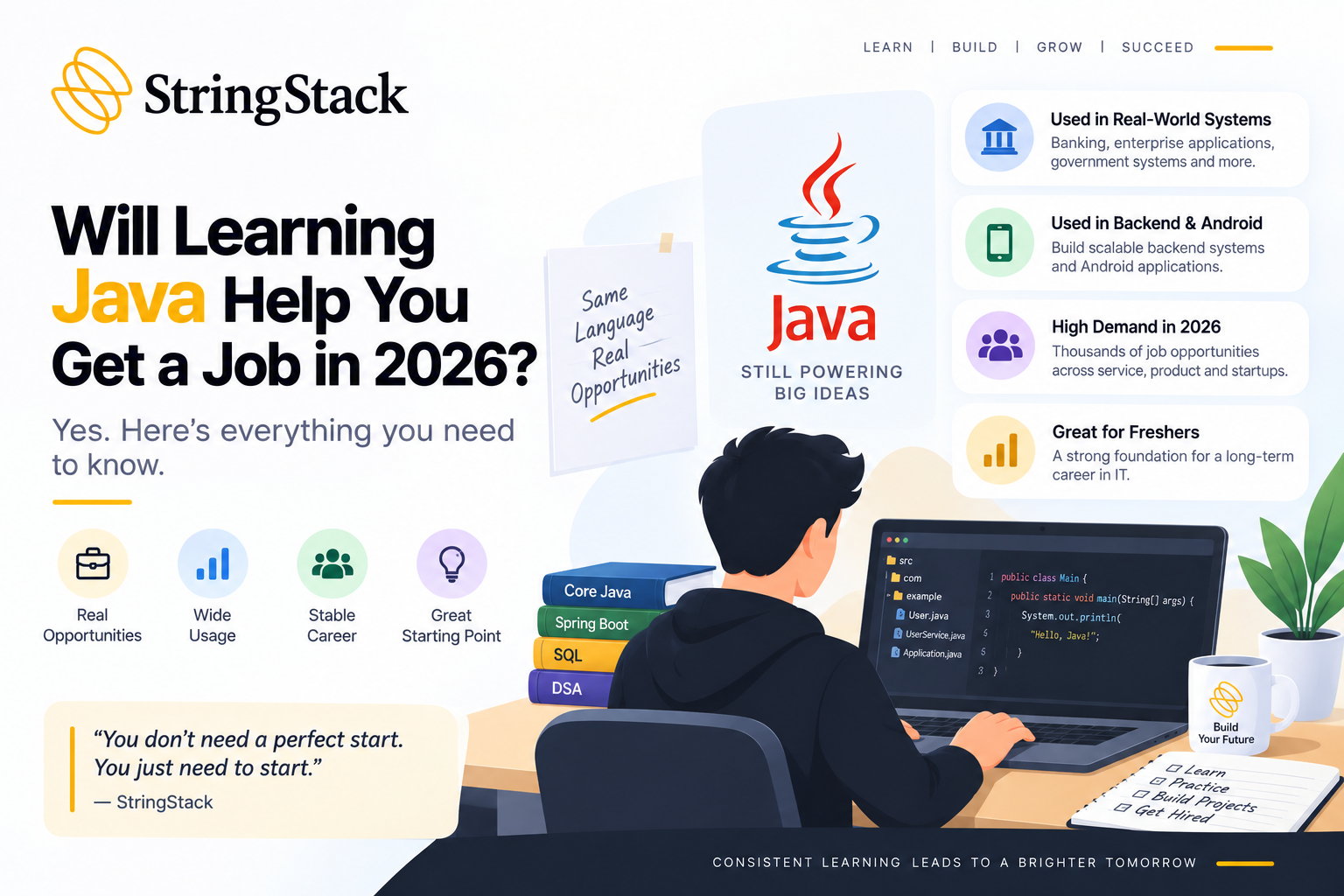
<p>If you are planning to start programming, one question will definitely come to your mind:</p>
<p><strong>“If I learn Java now, will it help me get a job in 2026?”</strong></p>
<p>This doubt is normal.</p>
<p>When you search online, you will see many languages—Python, JavaScript, C++, and more. It can be confusing to decide where to start.</p>
<p>The simple answer is this: <strong>Java is a good choice to begin your journey.</strong> It is widely used in real projects, and many companies continue to hire Java developers.</p>
<p><strong>Why Many Companies Use Java </strong></p>
<p>Java is used in many real-world systems.</p>
<p>Think about:</p>
<ul>
<li>Banking applications</li>
<li>Company internal software</li>
<li>Websites that handle many users</li>
</ul>
<p>These systems need to run properly every day. They cannot fail easily. That is why companies use technologies that are stable and reliable.</p>
<p>In real projects, Java is often used along with frameworks. These frameworks help developers write less code, organize applications better, and build features faster. This is one of the reasons Java is commonly used in companies.</p>
<p><strong>Where Java Is Used </strong></p>
<h2><strong>Backend Development</strong></h2>
<p>Backend is the part of an application that works in the background.</p>
<p>For example:</p>
<ul>
<li>When you log in</li>
<li>When your data is saved</li>
<li>When you search something</li>
</ul>
<p>Java is widely used to build these systems.</p>
<p>Developers use Java along with frameworks to:</p>
<ul>
<li>Handle user requests</li>
<li>Connect to databases</li>
<li>Build APIs</li>
</ul>
<p>This helps in creating applications that can handle many users at the same time.</p>
<p><strong>Android Applications </strong></p>
<p>Java has been used in Android development for many years.</p>
<p>Many apps are written in Java, and companies continue to maintain them. Because of this, Java knowledge is useful in Android development.</p>
<p>Java is used for:</p>
<ul>
<li>Writing app logic</li>
<li>Handling user actions</li>
<li>Managing background tasks</li>
</ul>
<p><strong>Large Company Systems </strong></p>
<p>Banks, insurance companies, and government systems use Java.</p>
<p>These systems:</p>
<ul>
<li>Handle large amounts of data</li>
<li>Need strong security</li>
<li>Must run without issues</li>
</ul>
<p>Java is suitable for these kinds of applications</p>
<p><strong>Job Opportunities in 2026 </strong></p>
<p>If you look at job platforms in India, you can clearly see the demand. </p>
<p>Here is a simple view based on May 2026 data: </p>
<p> </p>
<table border="1" cellspacing="0" style="border-collapse:collapse; width:624px">
<tbody>
<tr>
<td style="border-bottom:1px solid #000000; border-left:1px solid #000000; border-right:1px solid #000000; border-top:1px solid #000000; vertical-align:top">
<p><strong>Platform </strong></p>
</td>
<td style="border-bottom:1px solid #000000; border-left:1px solid #000000; border-right:1px solid #000000; border-top:1px solid #000000; vertical-align:top">
<p><strong>Approx. Java Job Openings (India) </strong></p>
</td>
</tr>
<tr>
<td style="border-bottom:1px solid #000000; border-left:1px solid #000000; border-right:1px solid #000000; border-top:1px solid #000000; vertical-align:top">
<p>Glassdoor </p>
</td>
<td style="border-bottom:1px solid #000000; border-left:1px solid #000000; border-right:1px solid #000000; border-top:1px solid #000000; vertical-align:top">
<p>13,000 – 14,000 jobs </p>
</td>
</tr>
<tr>
<td style="border-bottom:1px solid #000000; border-left:1px solid #000000; border-right:1px solid #000000; border-top:1px solid #000000; vertical-align:top">
<p>Foundit </p>
</td>
<td style="border-bottom:1px solid #000000; border-left:1px solid #000000; border-right:1px solid #000000; border-top:1px solid #000000; vertical-align:top">
<p>19,000+ jobs</p>
</td>
</tr>
<tr>
<td style="border-bottom:1px solid #000000; border-left:1px solid #000000; border-right:1px solid #000000; border-top:1px solid #000000; vertical-align:top">
<p>Bangalore (city level) </p>
</td>
<td style="border-bottom:1px solid #000000; border-left:1px solid #000000; border-right:1px solid #000000; border-top:1px solid #000000; vertical-align:top">
<p>5,000+ jobs</p>
</td>
</tr>
<tr>
<td style="border-bottom:1px solid #000000; border-left:1px solid #000000; border-right:1px solid #000000; border-top:1px solid #000000; vertical-align:top">
<p>Startups (Wellfound) </p>
</td>
<td style="border-bottom:1px solid #000000; border-left:1px solid #000000; border-right:1px solid #000000; border-top:1px solid #000000; vertical-align:top">
<p>100+ roles </p>
</td>
</tr>
</tbody>
</table>
<p>This shows that <strong>thousands of Java-related jobs are available at any given time</strong>. </p>
<p>These jobs come from:</p>
<ul>
<li>Service based companies</li>
<li>Product based companies</li>
<li>Startups</li>
</ul>
<p><strong>What Companies Expect from Freshers</strong> </p>
<p>Start small, understand the basics well, and keep improving step by step. </p>
<p>Companies usually look for students who are comfortable with fundamentals and can apply them in programs and real-world projects. </p>
<p>They mainly look for:</p>
<ul>
<li>Clear understanding of basics</li>
<li>Ability to solve problems</li>
<li>Interest in learning and building things</li>
</ul>
<p>Some important areas to focus on:</p>
<ul>
<li>Core Java concepts</li>
<li>Data Structures and Algorithms</li>
<li>Basic understanding of backend development</li>
<li>Working with databases like SQL</li>
</ul>
<p>As you start applying what you learn by building small projects, your confidence will grow, and you will understand better how real applications are built.</p>
<p><strong>How You Can Start Learning </strong></p>
<p><strong>Step 1: Learn Basics </strong></p>
<p>Start with:</p>
<ul>
<li>Classes and objects</li>
<li>OOP concepts</li>
<li>Collections</li>
<li>Exception handling</li>
</ul>
<p>Focus on understanding, not speed.</p>
<h2><strong>Step 2: Practice Regularly</strong></h2>
<p>Work on small problems.</p>
<p>Start with:</p>
<ul>
<li>Arrays</li>
<li>Strings</li>
<li>Linked Lists</li>
</ul>
<p>This improves your thinking.</p>
<p><strong>Step 3: Build Small Projects </strong></p>
<p>Do not wait to become perfect.</p>
<p>Start with simple projects like:</p>
<ul>
<li>Student Management System</li>
<li>Basic backend application</li>
<li>Simple API</li>
</ul>
<p>While building, you will also learn how frameworks and tools are used in real applications.</p>
<p><strong>Step 4: Learn Basic Tools </strong></p>
<p>Learn tools used in real jobs:</p>
<ul>
<li>Git and GitHub</li>
<li>SQL</li>
<li>APIs</li>
</ul>
<p>These help you work on real-world projects.</p>
<p><strong>Java and Other Languages </strong></p>
<table cellspacing="0" style="border-collapse:collapse; width:624px border: 2px solid white">
<tbody>
<tr>
<td style="border-bottom:1px solid #000000; border-left:1px solid #000000; border-right:1px solid #000000; border-top:1px solid #000000; vertical-align:top">
<p><strong>Language</strong></p>
</td>
<td style="border-bottom:1px solid #000000; border-left:1px solid #000000; border-right:1px solid #000000; border-top:1px solid #000000; vertical-align:top">
<p><strong>Main Use</strong></p>
</td>
<td style="border-bottom:1px solid #000000; border-left:1px solid #000000; border-right:1px solid #000000; border-top:1px solid #000000; vertical-align:top">
<p><strong>Demand</strong></p>
</td>
</tr>
<tr>
<td style="border-bottom:1px solid #000000; border-left:1px solid #000000; border-right:1px solid #000000; border-top:1px solid #000000; vertical-align:top">
<p>Java</p>
</td>
<td style="border-bottom:1px solid #000000; border-left:1px solid #000000; border-right:1px solid #000000; border-top:1px solid #000000; vertical-align:top">
<p>Backend, enterprise</p>
</td>
<td style="border-bottom:1px solid #000000; border-left:1px solid #000000; border-right:1px solid #000000; border-top:1px solid #000000; vertical-align:top">
<p>High</p>
</td>
</tr>
<tr>
<td style="border-bottom:1px solid #000000; border-left:1px solid #000000; border-right:1px solid #000000; border-top:1px solid #000000; vertical-align:top">
<p>Python</p>
</td>
<td style="border-bottom:1px solid #000000; border-left:1px solid #000000; border-right:1px solid #000000; border-top:1px solid #000000; vertical-align:top">
<p>Data Science, scripting</p>
</td>
<td style="border-bottom:1px solid #000000; border-left:1px solid #000000; border-right:1px solid #000000; border-top:1px solid #000000; vertical-align:top">
<p>High</p>
</td>
</tr>
<tr>
<td style="border-bottom:1px solid #000000; border-left:1px solid #000000; border-right:1px solid #000000; border-top:1px solid #000000; vertical-align:top">
<p>JavaScript</p>
</td>
<td style="border-bottom:1px solid #000000; border-left:1px solid #000000; border-right:1px solid #000000; border-top:1px solid #000000; vertical-align:top">
<p>Web development</p>
</td>
<td style="border-bottom:1px solid #000000; border-left:1px solid #000000; border-right:1px solid #000000; border-top:1px solid #000000; vertical-align:top">
<p>High</p>
</td>
</tr>
<tr>
<td style="border-bottom:1px solid #000000; border-left:1px solid #000000; border-right:1px solid #000000; border-top:1px solid #000000; vertical-align:top">
<p>C++</p>
</td>
<td style="border-bottom:1px solid #000000; border-left:1px solid #000000; border-right:1px solid #000000; border-top:1px solid #000000; vertical-align:top">
<p>Competitive coding </p>
</td>
<td style="border-bottom:1px solid #000000; border-left:1px solid #000000; border-right:1px solid #000000; border-top:1px solid #000000; vertical-align:top">
<p>Moderate </p>
</td>
</tr>
</tbody>
</table>
<p>Each language has its own purpose. What matters is how well you understand and use it. </p>
<p><strong>Conclusion</strong></p>
<p>Do not worry too much about choosing the “perfect” language.</p>
<p>Start with one. Learn it properly.</p>
<p>Practice every day, even if it is for a short time.</p>
<p>Build small projects. Make mistakes. Learn from them.</p>
<p>You don’t need a perfect start. You just need to start.</p>
<p>If you stay consistent and keep improving step by step, Java can help you build a good career in the coming years.</p>
<p> </p>
Why Java Continues to Create Job Opportunities in 2026