<p>Many students have one common doubt after completing college:</p>
<p><strong>“How do I enter the IT field in 2026 as a fresher?” </strong></p>
<p>When you look online, you will see many technologies, courses, and career advice. Because of this, many students feel confused about where to start and what to learn.</p>
<p>The important thing to understand is this:</p>
<p>You do not need to learn everything at once.</p>
<p>What matters is choosing one direction, learning it properly, and practicing regularly.</p>
<p><strong>Start with One Clear Path </strong></p>
<p>One common mistake many students make is trying to learn too many things together.</p>
<p>For example:</p>
<ul>
<li>Java today</li>
<li>Python tomorrow</li>
<li>AI next week</li>
<li>Web development after that</li>
</ul>
<p>This creates confusion and slows down learning.</p>
<p>Instead, choose one path based on your interest and spend time understanding it properly. </p>
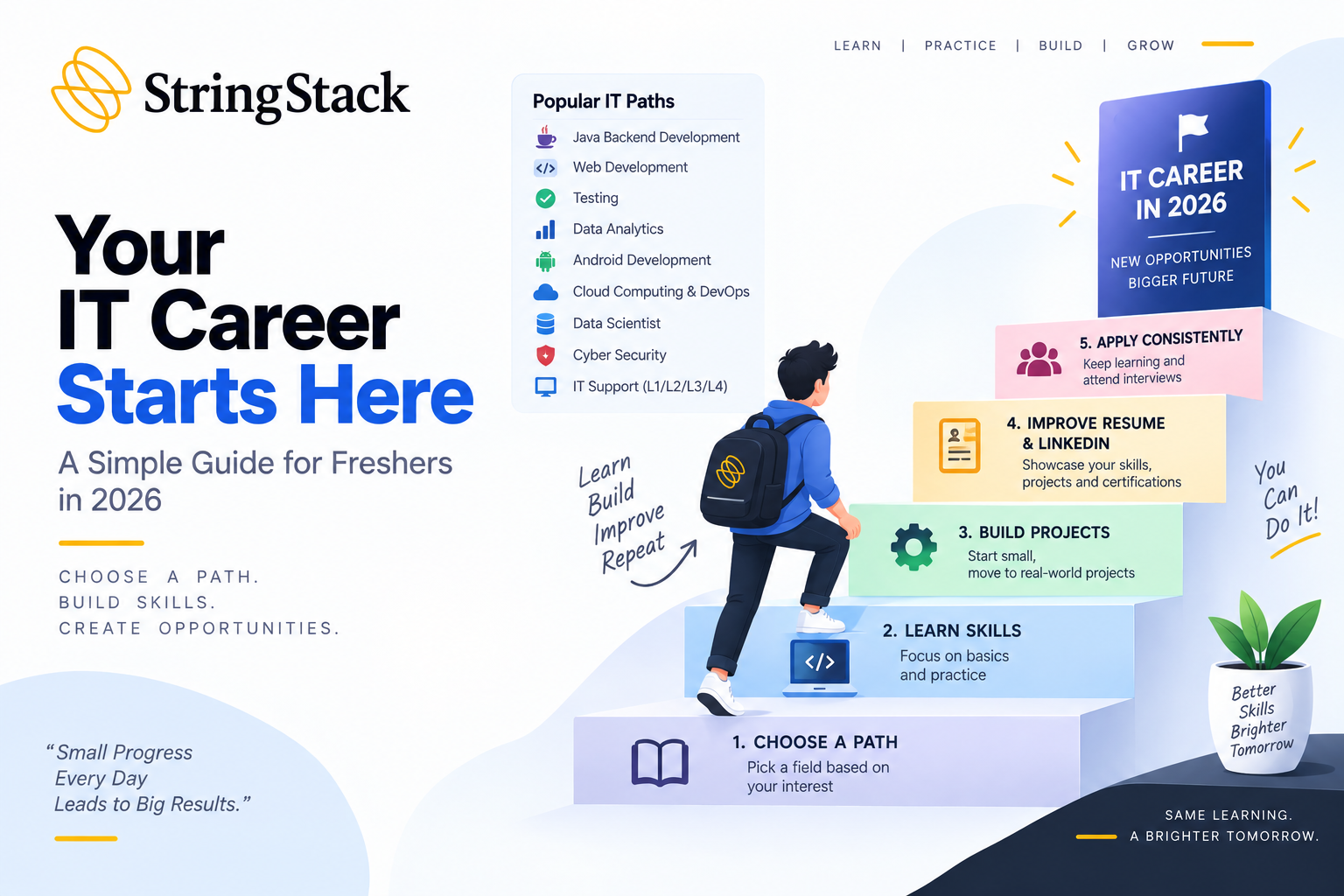
<p>Some common IT paths are:</p>
<table cellspacing="0" style="border-collapse:collapse; width:624px">
<tbody>
<tr>
<td style="border-bottom:1px solid #000000; border-left:1px solid #000000; border-right:1px solid #000000; border-top:1px solid #000000; vertical-align:top">
<p><strong>Field</strong></p>
</td>
<td style="border-bottom:1px solid #000000; border-left:1px solid #000000; border-right:1px solid #000000; border-top:1px solid #000000; vertical-align:top">
<p><strong>Skills </strong></p>
</td>
</tr>
<tr>
<td style="border-bottom:1px solid #000000; border-left:1px solid #000000; border-right:1px solid #000000; border-top:1px solid #000000; vertical-align:top">
<p>Java Backend Development </p>
</td>
<td style="border-bottom:1px solid #000000; border-left:1px solid #000000; border-right:1px solid #000000; border-top:1px solid #000000; vertical-align:top">
<p>Java, SQL, APIs, Spring Boot </p>
</td>
</tr>
<tr>
<td style="border-bottom:1px solid #000000; border-left:1px solid #000000; border-right:1px solid #000000; border-top:1px solid #000000; vertical-align:top">
<p>Web Development </p>
</td>
<td style="border-bottom:1px solid #000000; border-left:1px solid #000000; border-right:1px solid #000000; border-top:1px solid #000000; vertical-align:top">
<p>HTML, CSS, JavaScript, React </p>
</td>
</tr>
<tr>
<td style="border-bottom:1px solid #000000; border-left:1px solid #000000; border-right:1px solid #000000; border-top:1px solid #000000; vertical-align:top">
<p>Testing </p>
</td>
<td style="border-bottom:1px solid #000000; border-left:1px solid #000000; border-right:1px solid #000000; border-top:1px solid #000000; vertical-align:top">
<p>Manual Testing, Automation</p>
</td>
</tr>
<tr>
<td style="border-bottom:1px solid #000000; border-left:1px solid #000000; border-right:1px solid #000000; border-top:1px solid #000000; vertical-align:top">
<p>Data Analytics </p>
</td>
<td style="border-bottom:1px solid #000000; border-left:1px solid #000000; border-right:1px solid #000000; border-top:1px solid #000000; vertical-align:top">
<p>Python, SQL, Excel</p>
</td>
</tr>
<tr>
<td style="border-bottom:1px solid #000000; border-left:1px solid #000000; border-right:1px solid #000000; border-top:1px solid #000000; vertical-align:top">
<p>Android Development </p>
</td>
<td style="border-bottom:1px solid #000000; border-left:1px solid #000000; border-right:1px solid #000000; border-top:1px solid #000000; vertical-align:top">
<p>Java/Kotlin </p>
</td>
</tr>
<tr>
<td style="border-bottom:1px solid #000000; border-left:1px solid #000000; border-right:1px solid #000000; border-top:1px solid #000000; vertical-align:top">
<p>IT Support L3 & L4</p>
</td>
<td style="border-bottom:1px solid #000000; border-left:1px solid #000000; border-right:1px solid #000000; border-top:1px solid #000000; vertical-align:top">
<p>Networking (TCP/IP, DNS, DHCP, VPN, NAT), Operating Systems, Python Scripting </p>
</td>
</tr>
<tr>
<td style="border-bottom:1px solid #000000; border-left:1px solid #000000; border-right:1px solid #000000; border-top:1px solid #000000; vertical-align:top">
<p>Cloud Computing & DevOps </p>
</td>
<td style="border-bottom:1px solid #000000; border-left:1px solid #000000; border-right:1px solid #000000; border-top:1px solid #000000; vertical-align:top">
<p>AWS, Azure, or Google Cloud. containerization (Docker, Kubernetes),</p>
<p>CI/CD</p>
</td>
</tr>
<tr>
<td style="border-bottom:1px solid #000000; border-left:1px solid #000000; border-right:1px solid #000000; border-top:1px solid #000000; vertical-align:top">
<p>Data Scientist</p>
</td>
<td style="border-bottom:1px solid #000000; border-left:1px solid #000000; border-right:1px solid #000000; border-top:1px solid #000000; vertical-align:top">
<p>Python, Mathematics, Statistics, Machine Learning, AI </p>
</td>
</tr>
<tr>
<td style="border-bottom:1px solid #000000; border-left:1px solid #000000; border-right:1px solid #000000; border-top:1px solid #000000; vertical-align:top">
<p>Cyber Security </p>
</td>
<td style="border-bottom:1px solid #000000; border-left:1px solid #000000; border-right:1px solid #000000; border-top:1px solid #000000; vertical-align:top">
<p>Networking, Linux, Ethical Hacking, Security Tools </p>
</td>
</tr>
<tr>
<td style="border-bottom:1px solid #000000; border-left:1px solid #000000; border-right:1px solid #000000; border-top:1px solid #000000; vertical-align:top">
<p>IT Support (L1 & L2) </p>
</td>
<td style="border-bottom:1px solid #000000; border-left:1px solid #000000; border-right:1px solid #000000; border-top:1px solid #000000; vertical-align:top">
<p>Basic Networking, Operating Systems, Ticket Handling, System Troubleshooting, Customer Support </p>
</td>
</tr>
</tbody>
</table>
<p>You do not need to master everything in the beginning. Start with one area and improve step by step. </p>
<p><strong>Build Small Projects While Learning </strong></p>
<p>As you learn concepts, use them in small programs and projects.</p>
<p>Some simple project ideas:</p>
<ul>
<li>Student Management System</li>
<li>To-Do Application</li>
<li>Library Management System</li>
<li>Simple REST API</li>
<li>Portfolio Website</li>
</ul>
<p>Projects help you:</p>
<ul>
<li>Understand concepts better</li>
<li>Improve problem-solving</li>
<li>Gain confidence while coding</li>
</ul>
<p><strong>Build Real-World Projects</strong><br />
After learning the basics, move towards projects that solve real problems.</p>
<p>Examples:</p>
<ul>
<li>Attendance Management System</li>
<li>Expense Tracker</li>
<li>Food Ordering Application</li>
<li>E-commerce Website</li>
</ul>
<p>Real-world projects help you understand:</p>
<ul>
<li>How applications work</li>
<li>How databases are connected</li>
<li>How APIs are used</li>
<li>How development happens in companies</li>
</ul>
<p>These projects also make your resume stronger because they show practical understanding. </p>
<p><strong>Improve Your Resume and LinkedIn </strong></p>
<p>Learning skills is important, but presenting them properly also matters.</p>
<p>Your resume should clearly include:</p>
<ul>
<li>Skills</li>
<li>Projects</li>
<li>Internship experience (if any)</li>
<li>Certifications</li>
</ul>
<p>Update your LinkedIn profile regularly.</p>
<p>Add:</p>
<ul>
<li>Projects</li>
<li>Skills</li>
<li>Certifications</li>
<li>Internship details</li>
</ul>
<p>Many students get internship and job opportunities through LinkedIn connections and applications</p>
<p><strong>Apply Consistently </strong></p>
<p>Many students stop applying after a few rejections. This is common, but consistency matters.</p>
<p>Keep:</p>
<ul>
<li>Learning</li>
<li>Building projects</li>
<li>Improving your resume</li>
<li>Applying regularly</li>
</ul>
<p>Every interview helps you improve communication, confidence, and technical understanding. </p>
<p><strong>Conclusion</strong></p>
<p>Entering the IT field in 2026 is possible for freshers, but it requires consistent effort and patience.</p>
<p>Do not feel pressured by seeing too many technologies online.</p>
<p>Choose one path.<br />
Learn step by step.<br />
Build projects regularly.<br />
Keep improving consistently.</p>
<p>Small progress every day can create good opportunities over time.</p>
<p> </p>
How to Enter into IT in 2026 as a Fresher